
Buyer Briefing
4 min read · 790 words
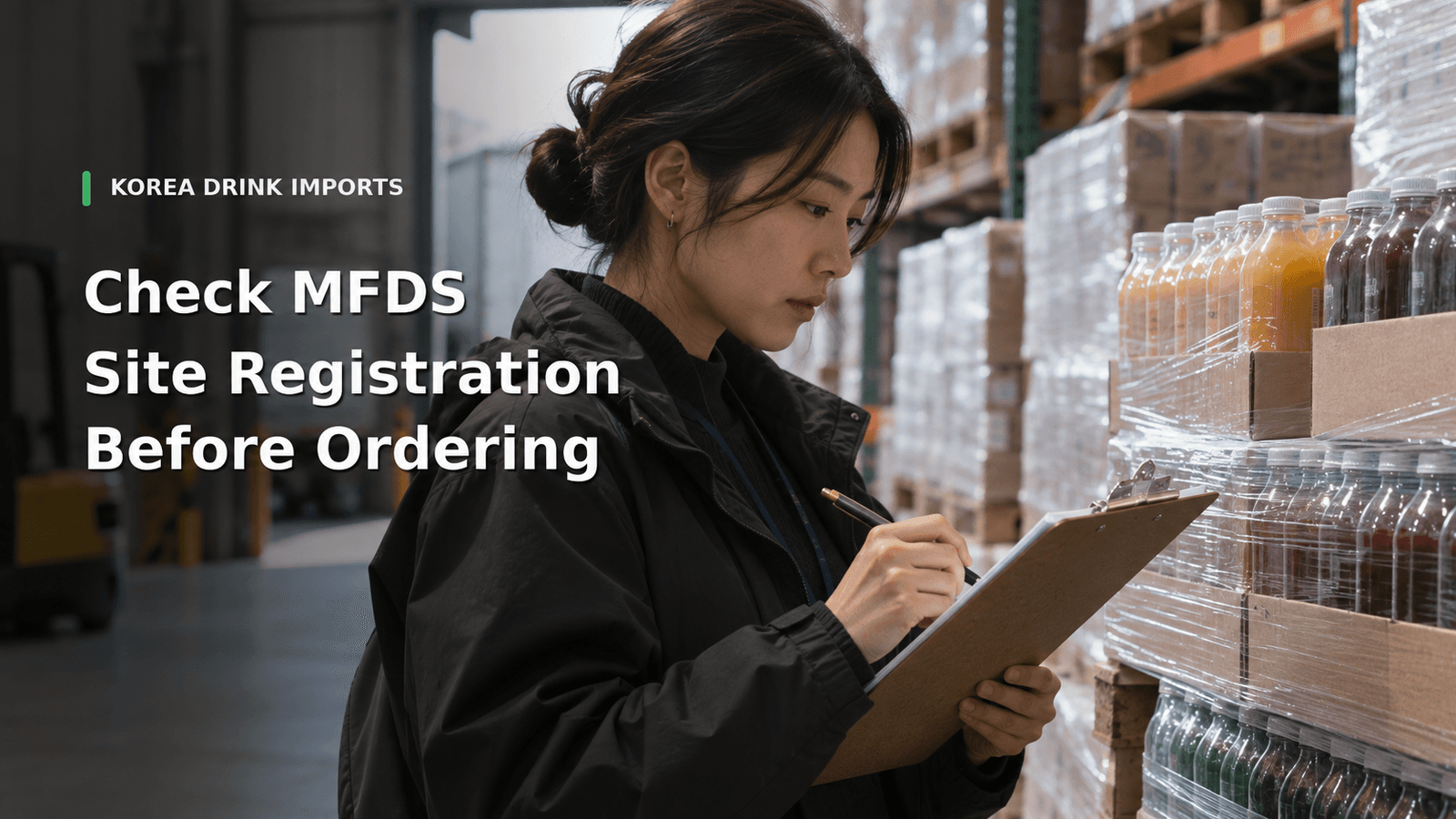
Before ordering beverages for South Korea, ask the Korean importer to match the **actual overseas food facility** against its record with the Ministry of Food and Drug Safety (MFDS), then compare that identity with the exact drink and purchase documents. Article 5 of Korea's Special Act on Imported Food Safety Control requires registration of relevant foreign food facilities **before the import declaration**. Checking before the purchase order is a prudent buyer control, not an additional statutory deadline. [1][2]
Before ordering beverages for South Korea, ask the Korean importer to match the actual overseas food facility against its record with the Ministry of Food and Drug Safety (MFDS), then compare that identity with the exact drink and purchase documents. Article 5 of Korea's Special Act on Imported Food Safety Control requires registration of relevant foreign food facilities before the import declaration. Checking before the purchase order is a prudent buyer control, not an additional statutory deadline. [1][2]
Separate the brand from the actual production facility
A beverage brand, exporter, invoice seller and physical producer can be different entities. A buyer should not search by brand alone and assume that the result identifies the site where the drink is produced or packed. Under the Special Act, a foreign food facility can be a site abroad where food is manufactured, processed, treated, packaged or stored. The registration relates to the relevant facility and its activities, not a blanket approval of every brand that sells the product. [1][2]
For a VINUT-labelled coconut water, juice, ready-to-drink tea or coffee, request the facility's legal name, physical address and actual role for that SKU from the supplying party. VINUT is the beverage brand in this example. Nothing in a brand catalogue establishes ownership of, or an MFDS registration for, a production facility.
Match the registered identity to the SKU
Article 5 identifies the facility's name, location and manufactured items among the registration matters. Korea's current implementing rules address supporting evidence of the foreign facility's registration or business identity. Ask the importer to use the official MFDS Imported Food Information Maru service to check the relevant record, rather than treating a supplier-sent screenshot as a complete verification. [1][3][4]
Use the following pre-order matching worksheet to identify discrepancies before approving a beverage order.
| Checkpoint | Record to compare | Release question |
|---|---|---|
| Brand and exact SKU | Quotation, specification, pack size and flavour | Is this the intended finished drink? |
| Actual facility | Supplier declaration and facility document | Who physically makes or handles this SKU? |
| Legal name and address | MFDS facility record and legal evidence | Do the facility details match? |
| Registered items/activities | MFDS record and finished-product description | Does the relevant product activity fit the record? |
| Registration reference and dates | Current MFDS record | Is the record valid for the planned import declaration? |
| Importer and shipment identity | Korean importer, invoice and purchase order | Who owns the Korea filing and discrepancy resolution? |
A name translated differently into English, a relocated site or a change from one facility to another deserves documentary reconciliation. Do not infer that similar corporate names, labels or addresses refer to the same registered operation.
Check the responsible applicant and record status
Article 5 allows the person intending to import the food or the operator of the foreign food facility to apply for registration. The law also requires registered changes to be filed. The statutory registration validity is generally two years, with an application to extend it before expiry. These obligations attach to the applicable registrant and facility, not automatically to the distributor's marketing brand. [1]
Ask the Korean importer to document who will verify the facility record, whether a modification or extension is needed, and whether MFDS has requested supporting information. MFDS describes online foreign-facility applications through Imported Food Information Maru and specifies that registration must be completed before import declaration. A normal published processing period should not be treated as guaranteed clearance for a particular consignment. [2][4]
For each order, obtain the facility's current MFDS record through the Korean importer and compare its scope with the actual supplier documentation. A facility listing alone does not establish that a specific VINUT-labelled beverage is cleared for the Korean market.
Resolve changes before placing the order
If the declared producer differs from the MFDS record, the record is expired, the item description is ambiguous or the supplier cannot substantiate the facility address, put the order's Korea-release decision on hold. Obtain an updated facility statement, verify the relevant manufacturing/packaging role and have the importer confirm the correct registration or amendment route with MFDS. MFDS requires foreign food facility registration before the import declaration. An unresolved registration can therefore prevent the importer from filing the shipment as planned. [1][2]
Agree a written go/no-go decision: verified facility + matching item scope + current record + named importer responsible for filing. Retain the MFDS check date, supporting evidence, specification revision and the person approving the transaction. Repeat the check when the actual facility, product activity or registration details change.
Facility registration alone does not certify that the drink's formulation, label, Korean-language information or entry inspection is compliant. Those questions require their own product-specific assessment. For product details on a potential VINUT order, contact VINUT. The importer remains responsible for confirming the Korean regulatory route for the actual transaction.
FAQ
Is an MFDS facility record the same as a beverage SKU approval?
No. It concerns the foreign facility and the relevant registered matters. A finished drink still needs its own applicable product, labelling and import checks. [1][2]
Can the Korean importer apply if the foreign facility has not registered itself?
Article 5 permits an intending importer or a foreign food-facility operator to file the relevant facility registration. The responsible party should confirm the correct case and supporting documents with MFDS. [1][2]
Does the purchase order have to wait until the facility is registered?
The statutory milestone cited here is **before the import declaration**, not the purchase order. Checking before ordering is a recommended commercial risk control. [1]
Regulatory information
- Markets
- KR
- Product groups
- Juice, Coconut water, Other beverage
- Korea National Law Information Center, Special Act on Imported Food Safety Control, Act No. 21525, effective 8 Oct 2026 (in Korean), especially Article 5
Korea National Law Information Center · Act No. 21525
unknown
- MFDS, Imported Food Safety (foreign food facility registration and applicant information)
Ministry of Food and Drug Safety (Korea)
unknown
- Korea National Law Information Center, Enforcement Rules of the Special Act on Imported Food Safety Control, Prime Ministerial Ordinance No. 2158, effective 30 Sep 2026, Article 2
Korea National Law Information Center · Ordinance No. 2158
unknown
- MFDS, Imported Food Information Maru (official application/registry portal, 2025-12-26 FAQ and 2026-09-01 manual listed)
Ministry of Food and Drug Safety (Korea)
unknown
Regulatory information is provided for trade reference. Confirm current requirements with the relevant authorities before making market decisions.
About this article
The VINUT editorial team publishes articles about beverage ingredients, product characteristics, and practical information for readers and international buyers.