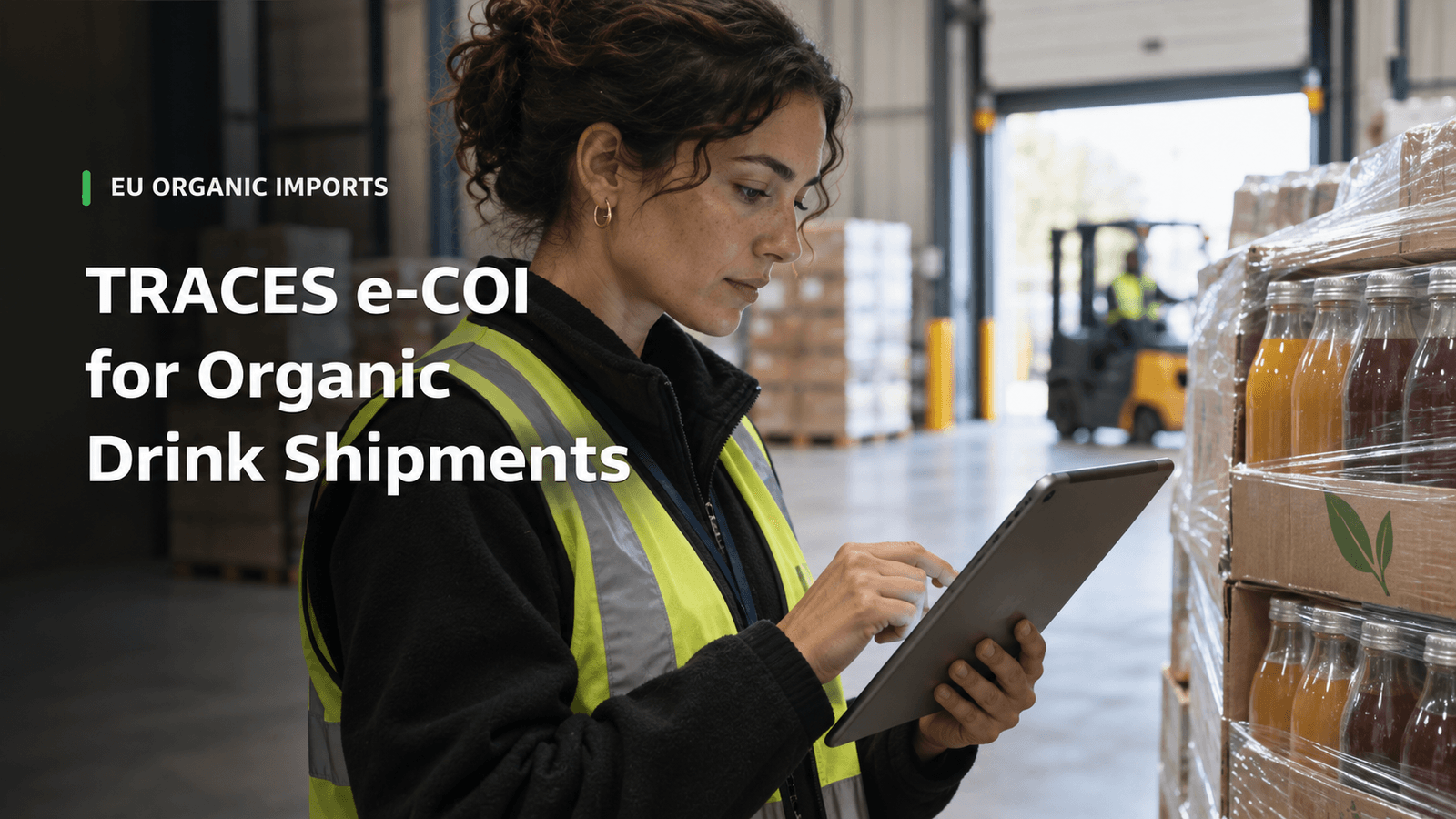

Buyer Briefing
4 min read · 749 words
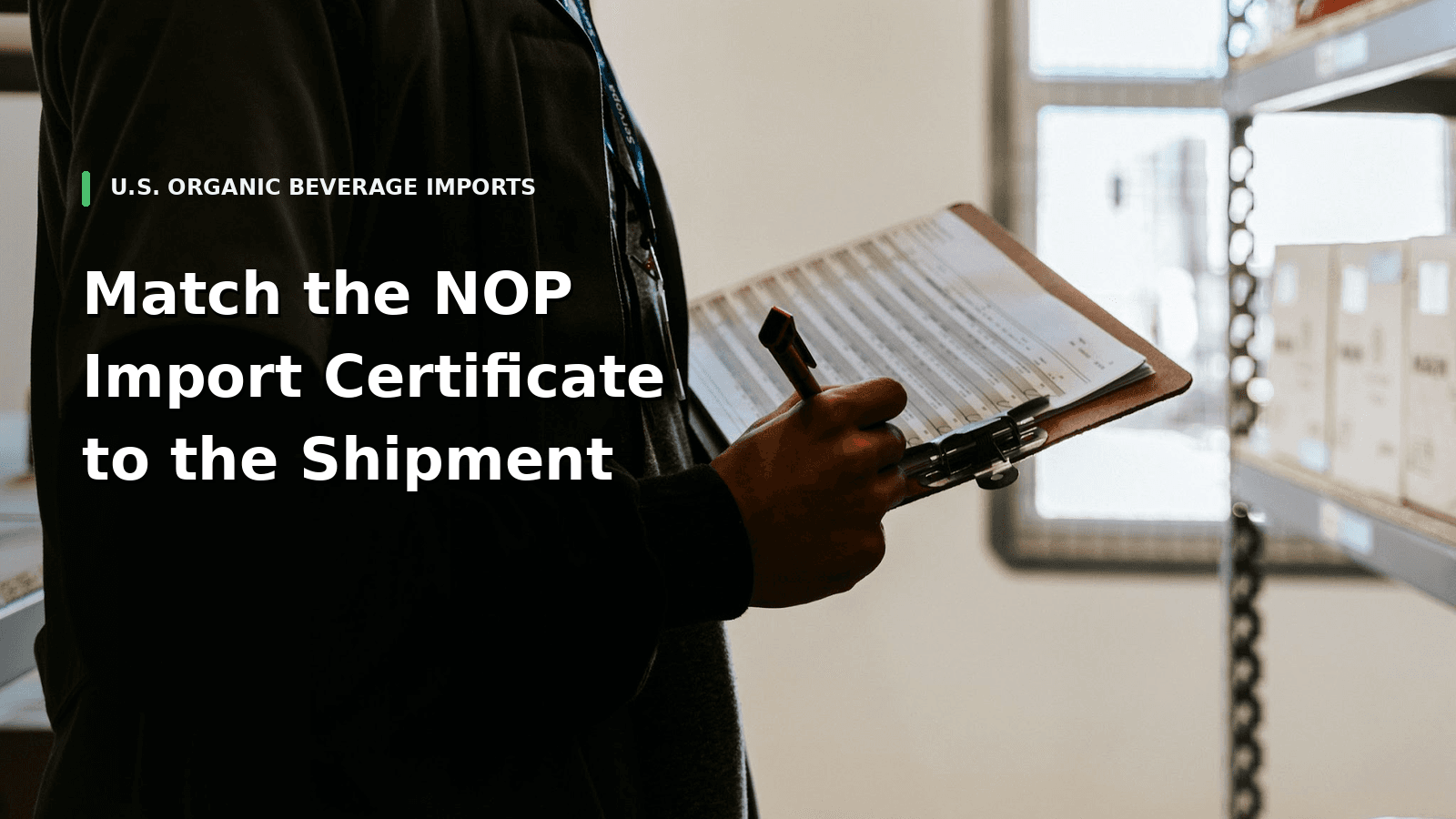
An organic claim on a beverage catalogue is not enough for an EU import. The importer should match the electronic certificate of inspection (e-COI) in TRACES with the shipment, the authorised control body, its own operator record and the first consignee. The certificate must be issued for the consignment before it leaves the exporting country. An EU authority makes the organic-release decision. See [Regulation (EU) 2021/2306, Articles 4–6](https://eur-lex.europa.eu/eli/reg_del/2021/2306/2024-12-02/eng).
An organic claim on a beverage catalogue is not enough for an EU import. The importer should match the electronic certificate of inspection (e-COI) in TRACES with the shipment, the authorised control body, its own operator record and the first consignee. The certificate must be issued for the consignment before it leaves the exporting country. An EU authority makes the organic-release decision. See Regulation (EU) 2021/2306, Articles 4–6.
Identify the organic import route
Start with the actual finished drink, origin, country of export, destination and intended organic status. A coconut-water product shown in an organic beverage catalogue is a sourcing lead, not proof that a particular batch is eligible for EU organic sale.
Under Regulation (EU) 2018/848, organic imports follow an applicable recognition or trade-agreement route. Confirm whether the control body is recognised for the country and product category involved. Recognition lists can change, including through Implementing Regulation (EU) 2026/1789. Do not assume that a supplier's organic certificate covers every processed drink.
Next, confirm the control location. Some products require checks at a border control post. Others may be checked at a point of release for free circulation under Delegated Regulation (EU) 2021/2305. The importer should confirm the route for the actual goods rather than select a port from a generic checklist.
Check the issuing control body and e-COI
The control authority or control body verifies the consignment and issues its e-COI in TRACES before departure. Under 2021/2306, Articles 3–5, it completes boxes 1–18 and uploads supporting commercial and transport records. The certificate is issued with a qualified electronic seal.
Compare the issuing body, certified exporter, product description, origin, quantities and transport evidence. For a processed organic beverage, ask whether the ingredient and processing records support the exact finished product. If selected package or transport details were unavailable at issuance, Article 5(3) allows specified information to be added within ten days, but always before authority verification and endorsement. This is not blanket permission to alter an unrelated shipment.
Match the importer, first consignee and shipment
The importer is an EU-established operator under organic controls that presents the goods for release, directly or through a representative. The first consignee is the EU-established controlled operator receiving them after release for preparation or marketing. These are distinct legal roles under Implementing Regulation (EU) 2021/2307, Article 2.
| e-COI check | Who should verify | Mismatch to resolve |
|---|---|---|
| Box 1 and boxes 4–9: bodies, exporter, origin | Exporter and issuing control body | Wrong operator or unrecognised scope |
| Box 12: EU importer and EORI | Importer | Incorrect EU entity or identifier |
| Box 13: goods, CN code, packs and quantity | Exporter with importer | Product or quantity differs from invoice |
| Box 10: border control post or point of release | Importer or representative | Incorrect control location for the goods route |
| Box 19: operator responsible for the consignment, if different | Importer | Missing or incorrect operator and EORI |
| Box 20: estimated arrival date and time | Importer or responsible operator | Arrival details differ from the notification |
| Box 24: first consignee | Importer before endorsement | Receiving operator differs from actual delivery |
| Box 30: authority's decision | Competent authority | No organic release decision recorded |
| Box 31: receipt declaration | First consignee after release | Packaging or receipt irregularities |
This is a practical cross-check. The e-COI model and box notes and 2021/2307, Articles 3–4 determine the formal entries. The importer or responsible operator must also submit prior arrival notification in TRACES under the applicable timing rules.
Resolve discrepancies before the organic-release decision
If the invoice describes a different beverage or the planned first consignee changes, ask the importer and issuing control body to reconcile the record before the authority acts. Under 2021/2306, Article 6, a competent authority may accept limited clerical corrections through the issuer, but the original certificate's consignment identity, traceability and guarantees cannot simply be rewritten.
The authority records its decision in box 30: release as organic, in-conversion or non-organic, refusal of release, or partial release with an extract of the certificate of inspection. Do not sell the consignment as organic merely because TRACES shows a draft or because a supplier provided an operation certificate. After release, the first consignee completes box 31 when receiving the goods, including its packaging assessment.
For each planned order, retain a shared reconciliation file linking the e-COI reference, invoice, packing list, transport records, import declaration and confirmed receiving operator. Release checks remain the responsibility of the competent authorities.
For an EU-bound organic drink inquiry, contact VINUT with the selected product, destination and packaging format to discuss which product records are available for buyer review.
FAQ
Does an EU organic operation certificate replace the e-COI?
No. Certification of an operator and the consignment-specific electronic certificate of inspection serve different purposes. The importer should confirm both the operator's applicable scope and the shipment's e-COI.
Can a customs broker replace the first consignee in box 24?
Not merely by acting as broker. The first consignee is the EU-controlled operator that receives the consignment after release for preparation or marketing. Verify the actual receiving entity.
Can the first consignee complete box 31 before customs release?
No. Under Article 4(1)(c) of Regulation 2021/2307, the first consignee completes that declaration in TRACES when receiving the consignment after release for free circulation.
Regulatory information
- Markets
- AT, BE, BG, HR, CY, CZ, DK, EE, FI, FR, DE, GR, HU, IE, IT, LV, LT, LU, MT, NL, PL, PT, RO, SK, SI, ES, SE
- Product groups
- Juice, Coconut water, Other beverage
- European Commission, Trade in organics (country routes and TRACES e-COI)
European Commission
unknown
- Regulation (EU) 2018/848, organic production and imports (Articles 45–48)
European Union / European Commission · 2018/848
unknown
- Commission Delegated Regulation (EU) 2021/2306, consolidated 02/12/2024, Articles 3–7 and Annex boxes
European Union / European Commission · 2021/2306
unknown
- Commission Implementing Regulation (EU) 2021/2307, consolidated 01/07/2022, Articles 2–4
European Union / European Commission · 2021/2307
unknown
- Commission Delegated Regulation (EU) 2021/2305, BCP exemptions/point of release
European Union / European Commission · 2021/2305
unknown
- Commission Implementing Regulation (EU) 2026/1789 of 23/07/2026, recognition-list amendment published 24/07/2026
European Union / European Commission · 2026/1789
unknown
- Commission Implementing Regulation (EU) 2021/2325, consolidated 27/07/2026
European Union / European Commission · 2021/2325
unknown
Regulatory information is provided for trade reference. Confirm current requirements with the relevant authorities before making market decisions.
About this article
The VINUT editorial team publishes articles about beverage ingredients, product characteristics, and practical information for readers and international buyers.