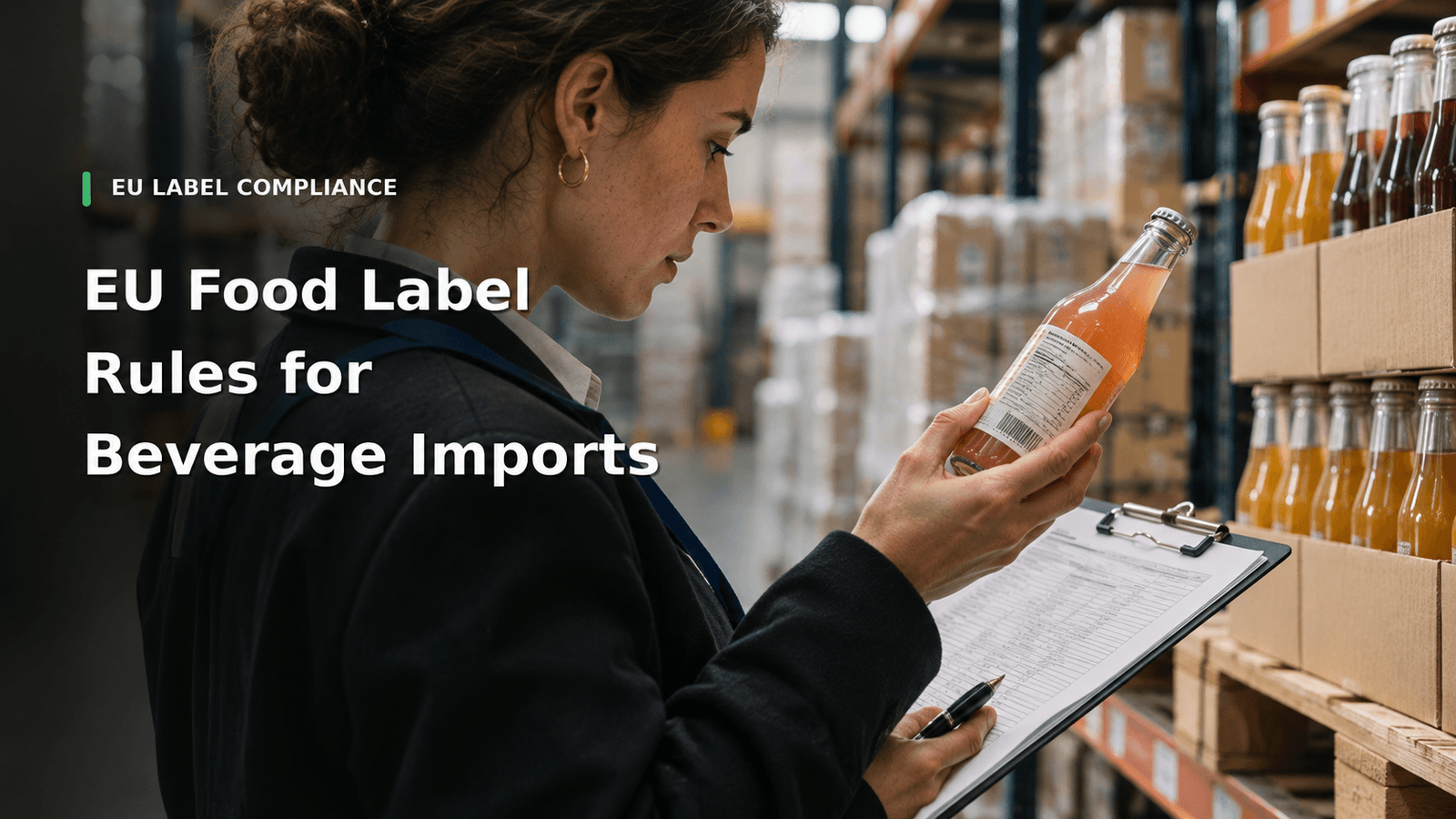

Buyer Briefing
4 min read · 759 words
For prepacked drinks offered to EU consumers through distance selling, the responsible food business operator must provide the applicable mandatory food information before the consumer completes the purchase, except the minimum-durability or use-by date. All mandatory particulars must be available at delivery. The practical first step is to identify the actual SKU, market, operator and sales channel, then compare the online listing against its approved product information. [1][2]
For prepacked drinks offered to EU consumers through distance selling, the responsible food business operator must provide the applicable mandatory food information before the consumer completes the purchase, except the minimum-durability or use-by date. All mandatory particulars must be available at delivery. The practical first step is to identify the actual SKU, market, operator and sales channel, then compare the online listing against its approved product information. [1][2]
Identify the distance-selling channel
Article 2(2)(u) of Regulation (EU) No 1169/2011 defines distance communication by the absence of simultaneous physical presence when the supplier and consumer conclude a contract. A consumer-facing webshop, marketplace listing or catalogue may therefore be in scope. The rule is about the information available before a consumer purchase, not just the visual design of a checkout button. [1]
Distinguish this transaction from a business-to-business request for quotation. An importer negotiating with a wholesaler is not automatically operating the same consumer checkout. Article 8 allocates food-information responsibilities across operators. Its paragraphs 7 and 8 require certain information to be passed between food businesses in the situations they specify; they do not turn every B2B quotation into a consumer distance sale. [1]
Separate pre-purchase and delivery information
Article 14(1)(a) requires the applicable mandatory information—other than the date specified in Article 9(1)(f)—to be available before the purchase is concluded. It may be shown on the distance-selling material or through another appropriate method clearly identified by the operator, without supplementary cost to the consumer. At delivery, Article 14(1)(b) requires all mandatory particulars, including the applicable date information. [1][2]
Examples to assess for the exact drink include its legally correct food name, ingredients and highlighted allergens, net quantity, conditions of storage or use, details of the responsible operator, and a nutrition declaration where required. Origin, instructions or other particulars may also apply depending on the product and rules. This is a data-mapping exercise, not a substitute for the full Article 9 and product-specific assessment. [1][3]
The information must be accessible in a language that meets Article 15 and the relevant Member State's requirements. An English-language catalogue does not automatically make a consumer listing suitable for every EU destination. [1]
Match the listing to the actual SKU
A branded drink family can contain different flavours, formulations, pack sizes or markets. The online information should therefore be linked to the exact product record rather than copied from a similar SKU. An original coconut-water variant and a pulp-containing or flavoured variant, for example, should not be assumed to have identical ingredient lists or nutrition values. This is an illustration of the review method, not a claim about a specific VINUT formula.
For each planned listing, the importer or retail content team should obtain the current product name, formulation or approved specification, label artwork version, package size and intended Member State. If the source data changes, the retailer should check every language and marketplace version before the updated offer remains live. Product photographs can support recognition, but a photograph alone should not be assumed to communicate every required detail clearly.
Check missing information before the offer goes live
Use this short release checklist to divide actions across the supply chain. The responsibilities shown are suggested workflow assignments, not an assertion that EU law prescribes these exact internal job titles:
• Consumer-facing offer — Retailer or online seller: make the applicable mandatory information available before the purchase is concluded, using a clear, no-extra-cost access route. [1]
• Product data — Importer and product-information owner: reconcile the listing with the relevant formulation, approved label version, pack size and destination language.
• Delivery — Responsible food business operator: check that all applicable mandatory particulars are available when the consumer receives the drink. [1]
• Change control — Distributor and retailer: record who reviews changes to ingredients, allergens, nutrition, packaging or translated information before a listing is reused.
A practical test is to open the consumer-facing listing as a new shopper and try to obtain the applicable information before confirming a purchase. If a fact is missing, inconsistent across flavour variants, or accessible only after the sale, stop the listing for correction. Automatic vending machines and automated commercial premises are exempt from the Article 14(1)(a) pre-purchase rule under Article 14(3). Non-prepacked foods follow Article 14(2) and Article 44, while other product-specific exemptions and national measures still require a separate assessment. [1][2]
For a defined VINUT drink and EU destination, ask about the corresponding product specification and available label information. The local importer and retailer remain responsible for checking the applicable requirements before their consumer listing goes live. Contact VINUT: /contact
FAQ
Does a QR code on the delivered bottle replace online information?
No. A code seen only at delivery cannot by itself meet the pre-purchase availability requirement. A clearly identified online information route may be considered if it provides the required information at the proper time without supplementary consumer cost. [1][2]
Can one translated listing serve every EU country?
Not necessarily. Article 15 sets the language principle, and Member States can require use of specified official languages. The distributor must check the actual country where the drink is marketed. [1]
Regulatory information
- Markets
- AT, BE, BG, HR, CY, CZ, DK, EE, FI, FR, DE, GR, HU, IE, IT, LV, LT, LU, MT, NL, PL, PT, RO, SK, SI, ES, SE
- Product groups
- Juice, Coconut water, Other beverage
- Regulation (EU) No 1169/2011, Articles 2, 8, 9, 14 and 15, consolidated EUR-Lex version displayed as 1 April 2025
European Union / European Commission · 1169/2011
unknown
- European Commission, Distance Selling
European Commission
unknown
- European Commission, Mandatory Food Information
European Commission
unknown
Regulatory information is provided for trade reference. Confirm current requirements with the relevant authorities before making market decisions.
About this article
The VINUT editorial team publishes articles about beverage ingredients, product characteristics, and practical information for readers and international buyers.