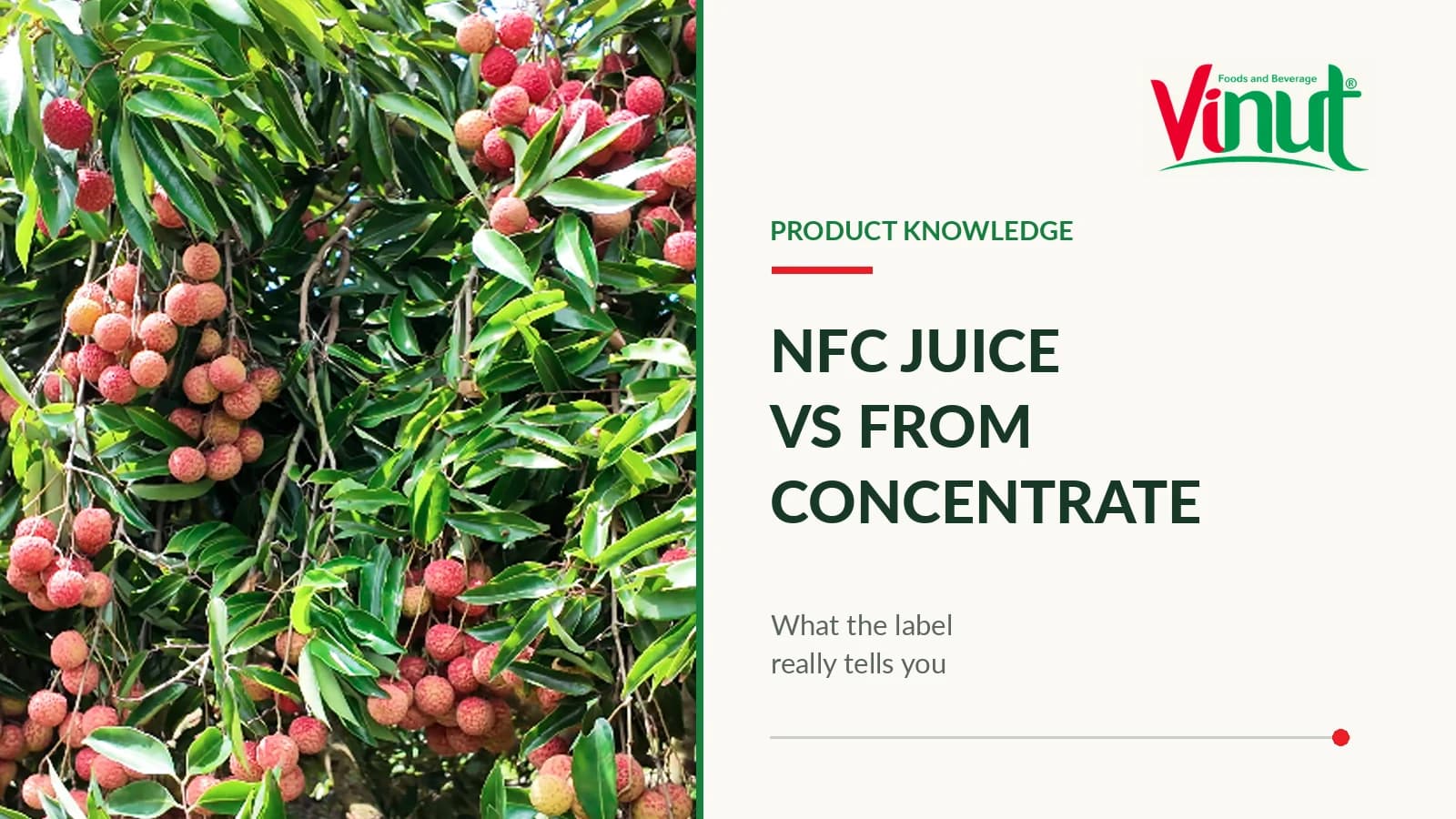
Buyer Briefing
4 min read · 856 words
NFC juice avoids concentration and reconstitution. Juice from concentrate has water removed and later restored. Both may qualify as 100% juice under applicable rules. Compare finished-drink ingredients, nutrition and processing wording.
- NFC describes a production route, not rawness or nutritional superiority.
- From-concentrate juice may still qualify as 100% juice.
- U.S. rules distinguish percentage-juice declarations from from-concentrate naming.
- EU fruit-juice rules also distinguish product categories.
- Compare finished drinks using the same serving-volume basis.
Not-from-concentrate (NFC) juice is made without concentrating the extracted juice and then reconstituting it. Juice from concentrate is prepared using juice from which some water has been removed and later replaced. The distinction describes a processing route, not an automatic difference in juice percentage, sugar, taste or nutritional quality. To choose, compare two finished drinks of the same category and read their complete labels.
How are not-from-concentrate and from-concentrate juices made?
For an NFC product, juice is obtained from fruit without an intervening concentration-and-reconstitution step. It can still be filtered, pasteurised or otherwise processed and packaged. NFC therefore does not necessarily mean raw, unpasteurised, freshly squeezed at the shop or free from additional ingredients in the finished beverage.
For juice from concentrate, part of the water is removed after extraction, producing a concentrated juice ingredient. Water is then added back when preparing the finished juice. The precise ingredients and permitted processing methods depend on the product category and market. The relevant comparison is between two ready-to-drink juices, not a glass of NFC juice and an undiluted concentrate used as an ingredient.
- NFC route: fruit → juice extraction → applicable preparation → finished packaged drink.
- From-concentrate route: fruit → juice extraction → water removal → concentrated ingredient → water restoration and applicable preparation → finished packaged drink.
Both routes can produce packaged drinks intended for direct consumption. The steps describe general processes and are not a claim about a particular VINUT product or manufacturing line.

Can both types be labelled 100% juice?
Yes, under applicable product rules. A properly reconstituted juice can qualify as 100% juice, just as a directly expressed juice can. Juice percentage and the production route answer different questions: one describes how much of the finished beverage counts as juice under the applicable rules, while the other describes whether concentration and reconstitution occurred.
For U.S. products, 21 CFR 101.30 governs juice-percentage declarations, including calculations for juice reconstituted from concentrate. 21 CFR 102.33(g) covers wording such as “from concentrate” or “reconstituted” in juice names, with specified exceptions. These are U.S. provisions, not universal naming instructions.
In the European Union, the framework based on Directive 2001/112/EC, as amended by Directive (EU) 2024/1438, distinguishes fruit juice from fruit juice from concentrate. The amended rules apply from 14 June 2026. Product names and ingredient requirements must be assessed under the law of the market where the drink is sold.
Which label details should you compare?
When choosing between two packages, use the same sequence for both. A quick decision is more reliable when the products have similar fruit types, serving volumes and market-specific labelling.
- Product identity: Check whether each package is actually fruit juice, a juice drink, nectar or another defined beverage. A claim about the processing of one juice ingredient does not automatically determine the finished product category.
- Processing statement: Look for NFC, not from concentrate, from concentrate or reconstituted, interpreted under that market's requirements.
- Juice content: Read the percentage-juice declaration where applicable. A “from concentrate” statement does not alone mean the drink contains less than 100% juice.
- Ingredients and nutrition: Compare the complete ingredient list, any declared sugars and relevant nutrients on the same volume or serving basis. Neither route establishes a universal nutrient advantage.
- Use and storage: Check net volume, package format and the stated storage directions before and after opening. The NFC label is not a storage instruction.
This method helps separate the facts a package supplies from assumptions suggested by a photograph or a short marketing phrase. If you are comparing juice with a juice drink rather than two 100% juices, VINUT's guide to juice versus juice drink addresses that separate category question.
Does one processing route taste better or contain more nutrients?
Not as a general rule. Fruit variety, formulation, processing, packaging and storage can all affect a finished beverage. The statements “NFC” and “from concentrate” are insufficient by themselves to establish which product is sweeter, has more vitamin C, contains fewer calories or will taste better to an individual drinker.
Consider two hypothetical ready-to-drink orange juices sold under the same market rules. Both may declare 100% juice, while one states NFC and the other states from concentrate. Those declarations tell you about juice content and processing. They do not provide measured sugar or vitamin values, a blind taste-test result or a shelf-life comparison. Those conclusions require actual product evidence.

Which option is a better fit for you?
Choose an NFC juice when avoiding the concentration-and-reconstitution step matters to you and the drink's verified ingredients, flavour and packaging suit your needs. Choose a from-concentrate juice when its actual ingredient list, product characteristics and serving format better match your preferences. Neither description is a shortcut for “healthier”, “fresher” or “better quality”.
When comparing VINUT products, use the exact SKU's current label for its processing description, juice content and nutrition rather than extending a claim from a category page to every drink. Explore the VINUT fruit-juice collection to find product options, then review each item on its own merits.
Bottom line: NFC and from-concentrate explain how the juice was prepared. The finished drink's identity, ingredients, nutrition information and your own preferences explain what to choose.
VINUT products
Explore related drinks
View ingredients, sizes and packaging.


FAQ
Does NFC mean cold-pressed or unpasteurised?
No. Not from concentrate describes the absence of concentration and reconstitution. A packaged NFC juice can still undergo other processing, including heat treatment, depending on the product.
Is undiluted juice concentrate the same as ready-to-drink juice from concentrate?
No. A concentrate is an ingredient with some water removed. Ready-to-drink juice from concentrate is prepared after appropriate reconstitution. Compare finished drinks on equivalent terms.
Can a juice blend include both NFC and from-concentrate components?
A blend may combine juice ingredients made by different routes. Read the complete ingredient statement and the processing declarations required by the market where the product is sold.
Does the phrase “from concentrate” prove that sugar has been added?
No. It identifies a processing route. Determine the product's sugar and other ingredients from the complete formulation, ingredient list and nutrition information. Apply the market's product-category rules.
About this article
The VINUT editorial team publishes articles about beverage ingredients, product characteristics, and practical information for readers and international buyers.